Key Takeaways
- A complete request for quote (RFQ) package needs 3D STEP or IGES files, 2D drawings, exact material grades, quantities, finishes, and inspection requirements. These details let Mexico CNC machining suppliers quote accurately.
- Every quote should clearly state Incoterms, importer of record, whether duties are included, and how freight is handled. Without these details, you cannot fairly compare Mexico pricing to United States (US) quotes.
- The United States-Mexico-Canada Agreement (USMCA) does not automatically make Mexico parts duty-free. Origin rules, material source, and Harmonized Tariff Schedule (HTS) classification determine whether tariffs apply.
- Section 232 steel and aluminum duties follow where the metal was produced, not where machining happens. Chinese-origin metal machined in Mexico can still face layered tariffs.
- Redstone Manufacturing quotes a single landed unit price on modified Delivered Duty Paid (DDP) terms, acts as importer of record, and backs quality and recourse under a US contract.
Start your CNC quote with Redstone Manufacturing.
How To Read A CNC Machining Quote From Mexico Line By Line
A complete Mexico CNC machining quote should itemize several things: unit price at the quoted quantity, tooling cost and tooling ownership, sample or first-article cost, freight, duties and tariffs, lead time for samples versus production, payment terms, and the Incoterm. A quote that says only “unit price per part” tells you the price. A quote that itemizes material, machining time, setup, finishing, inspection, and packaging tells you the story behind that price.
What is often missing or buried in a Mexico quote matters more than what is clearly listed. The most common omissions are:
- Whether the quoted price is ex-works, meaning the buyer owns everything after the part leaves the building, or landed, meaning freight and duties are included.
- Whether duties are included at rates as of the quote date or excluded entirely.
- Whether freight is prepaid and added or silently baked into the unit price.
- Whether tooling is quoted separately from the production parts order.
- Who is the importer of record, meaning the party legally responsible for classifying the goods, filing customs paperwork, and paying duties and tariffs.
If the quote does not say who is importer of record and whether duties are included, the number cannot be compared to anything else. A quote missing those two items cannot sit next to a US quote and receive an honest evaluation, because the two numbers do not cover the same scope.
Redstone Manufacturing quotes a single landed unit price on modified DDP terms. Redstone acts as importer of record into the US, folds tariffs and duties into the unit price at rates in effect as of the quote date, and quotes freight separately as prepaid and add. That structure gives the customer one number that covers the part at their dock, with no customs exposure and no surprise invoices.
Do Mexico CNC Machining Quotes Include Tariffs And Shipping?
Mexican CNC machining suppliers such as EMEC in Monterrey offer Ex Works (EXW) among their shipping Incoterms, making ex-works a common quoting basis for Mexico machining quotes. Under EXW, the buyer owns everything after the part leaves the building: freight, customs brokerage, HTS classification, and duty. HTS classification is the process of assigning the code that determines the duty rate, and it requires expertise most buyers do not have.
A quote can look cheaper than a US quote and end up more expensive once those costs are added. A quoted part price can rise substantially after ocean freight, duties, and customs fees are applied. The same pattern appears with Mexico quotes when the buyer is not an importer and has not modeled those costs.

The information in this section reflects tariff conditions as of 2026-09-22. Rates change, so any quote should be checked against current rates at the time of order.
How USMCA Affects CNC Machining Quotes From Mexico
Tariff exposure on a Mexico quote also depends on whether the part qualifies for USMCA preferential treatment. USMCA, the United States-Mexico-Canada Agreement that replaced NAFTA on July 1, 2020, provides lower or zero duties for qualifying goods. That treatment depends on North American content thresholds rather than where final assembly happens.
A part machined in Mexico from Chinese or other non-North American material does not automatically qualify for preferential treatment just because it was finished in Mexico. The origin of the inputs matters. A buyer who assumes “made in Mexico” equals “duty-free” may be surprised at the border, because “made in Mexico” and “originating under USMCA” describe different things.
The key question is whether the inputs and processing meet the product-specific rule for that part’s HTS classification, regardless of where the part was made. That analysis requires someone who knows the bill of materials, the origin of each input, and the applicable rule. Redstone Manufacturing works through that analysis as part of the quoting process.
Request a USMCA-aware quote review.
Why A Mexico Quote May Not Be Duty-Free For Steel And Aluminum
For steel and aluminum, duty follows where the metal was produced, not where the part was machined. A steel bracket machined in Mexico from Chinese steel still faces steel-related duties even though the machining happened in Mexico.
Section 232 is the national-security tariff statute that covers steel, aluminum, and derivative products. Section 301 is a country-based tariff statute, and the China duties are the ones buyers usually recognize. The two stack, so both can apply to the same part at the same time. Section 232 derivative product coverage has also been expanding, with new HTS codes added in 2025 and 2026, so parts that were not previously covered may now be in scope. The calculation basis also shifted from metal content to full product value, which caught many buyers mid-program.
Understanding the layering matters more than knowing any specific rate, because rates move and layering does not. The structure stays the same: Section 232 applies to the metal regardless of where the part was made, Section 301 applies based on where the part originated, and both sit on top of the ordinary most-favored-nation (MFN) duty rate for the part’s HTS code.
This layering also creates a legitimate structure for some programs. A buyer can purchase US-origin material, ship it out for casting or machining, and bring the finished part back. Because duty on steel and aluminum follows where the metal was produced, US-origin material carries a different duty profile than foreign-origin material, even when the machining happens overseas. Redstone Manufacturing works through this analysis for customers whose parts involve steel or aluminum content.
Tariff information in this section reflects conditions as of 2026-09-22. Rates and derivative product lists change, so any program should be verified at the time of order.
How To Compare CNC Machining Quotes From Mexico And The US
A US quote usually includes elements that a direct Mexico quote does not. There is an American point of contact who answers the phone. The contract is enforceable under US law. If a part is wrong, there is a clear path to repair, replacement, or refund. Quality management, design for manufacturability (DFM) review, inspection, freight, customs, HTS classification, and tariff exposure all sit with the supplier.
A Mexico quote from a direct shop transfers much of that work to the buyer. Supplier selection, quality management, DFM, inspection, freight, customs brokerage, HTS classification, and tariff exposure become the buyer’s job, usually with payment demanded in advance and little practical recourse if something fails. Many buyers in this position have never handled those tasks. As one buyer put it directly: “We’re not importers. We don’t have that skill set.”
Redstone Manufacturing fills the gap between those two options. It combines overseas production cost with a US company that owns the outcome. A single American point of contact acts as importer of record on modified DDP terms, so you receive one landed price agreed in advance. Repair, replacement, or refund responsibility sits with a US company under a US contract. Nothing is owed until samples are approved and in-spec production parts ship, with terms of Net 30 or Net 60 from ship date.
When comparing quotes, focus on total landed cost rather than unit price. That means adding freight, duties, customs brokerage, the buyer’s own time managing the program, and the cost of a bad batch with no recourse. A quote that looks cheaper on unit price can still end up more expensive once those factors are included.
The table below shows how direct Mexico quotes, US shop quotes, and Redstone quotes differ on the main drivers of total landed cost.
| Attribute | Direct Mexico Quote (Ex-Works) | US Shop Quote | Redstone Manufacturing Quote |
|---|---|---|---|
| Unit price basis | Ex-works: buyer owns freight, customs, and duties after the part leaves the building | Typically includes domestic freight; no import duties apply | Modified DDP: single landed unit price with duties folded in at rates as of quote date; freight quoted separately, prepay and add |
| Importer of record | Buyer | Not applicable for domestic production | Redstone Manufacturing acts as importer of record into the US |
| Tariff and duty handling | Buyer’s responsibility: HTS classification, duty payment, and rate-change tracking | No import duties on domestic production | Redstone classifies by end use, folds duties into unit price at rates in effect as of quote date, and adjusts at shipment if rates change |
| Recourse if a part is wrong | Buyer must pursue a supplier overseas; prepayment is common, so money has already left | US contractual accountability; enforceable under US law | Repair, replacement, or refund responsibility sits with a US company under a US contract; nothing owed until in-spec parts ship |
Compare your current quote with Redstone.
How To Vet A Mexico CNC Machining Shop Before You Request A Quote
Vetting a Mexico shop before sending an RFQ saves time and avoids common failure modes. The questions below are practical, not theoretical. A shop that cannot answer them clearly before the order will not answer them clearly after the purchase order (PO) is placed.
Ask the following before requesting a quote:
- Who inspects the parts before shipment, and where does that inspection happen? In-person inspection at origin, before parts leave the building, is the only reliable way to catch defects before they land at your dock.
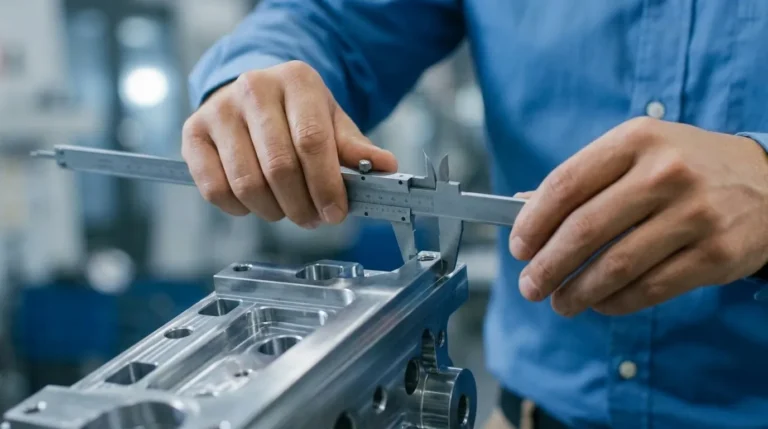
- Can the shop provide a first-article inspection (FAI) report and coordinate measuring machine (CMM) dimensional verification? An FAI measures every dimension on the drawing for the first parts off a new setup, confirming the process is capable before volume runs.
- Do they retain mill test certificates, meaning the mill’s own document certifying the chemical and mechanical properties of the metal it supplied, and can they issue Restriction of Hazardous Substances (RoHS) and Registration, Evaluation, Authorisation and Restriction of Chemicals (REACH) declarations on request?
- Who is the importer of record? If the answer is “your broker handles it,” the buyer owns the customs exposure.
- What happens if a batch is out of spec? The right answer involves a documented corrective-action process. A supplier that can explain a recent nonconformance and what changed afterward is more credible than one claiming defects never occur.
- How do they communicate, and how fast do they respond before the order? Slow communication before the order predicts worse communication after the PO. Data shows that more than 40% of RFQs that do not receive a response within 24 hours end up with another supplier.
Redstone Manufacturing runs production at its own facilities overseas, including in Mexico, with Redstone staff inspecting in person before every shipment. Redstone also maintains full-time engineering staff on the ground in its facility in China and can move a program between China, India, Taiwan, Vietnam, and Mexico if tariffs or conditions change. That flexibility means the customer does not have to restart the qualification process when the trade environment shifts.
How To Tell If Your Part Needs 5-Axis Machining
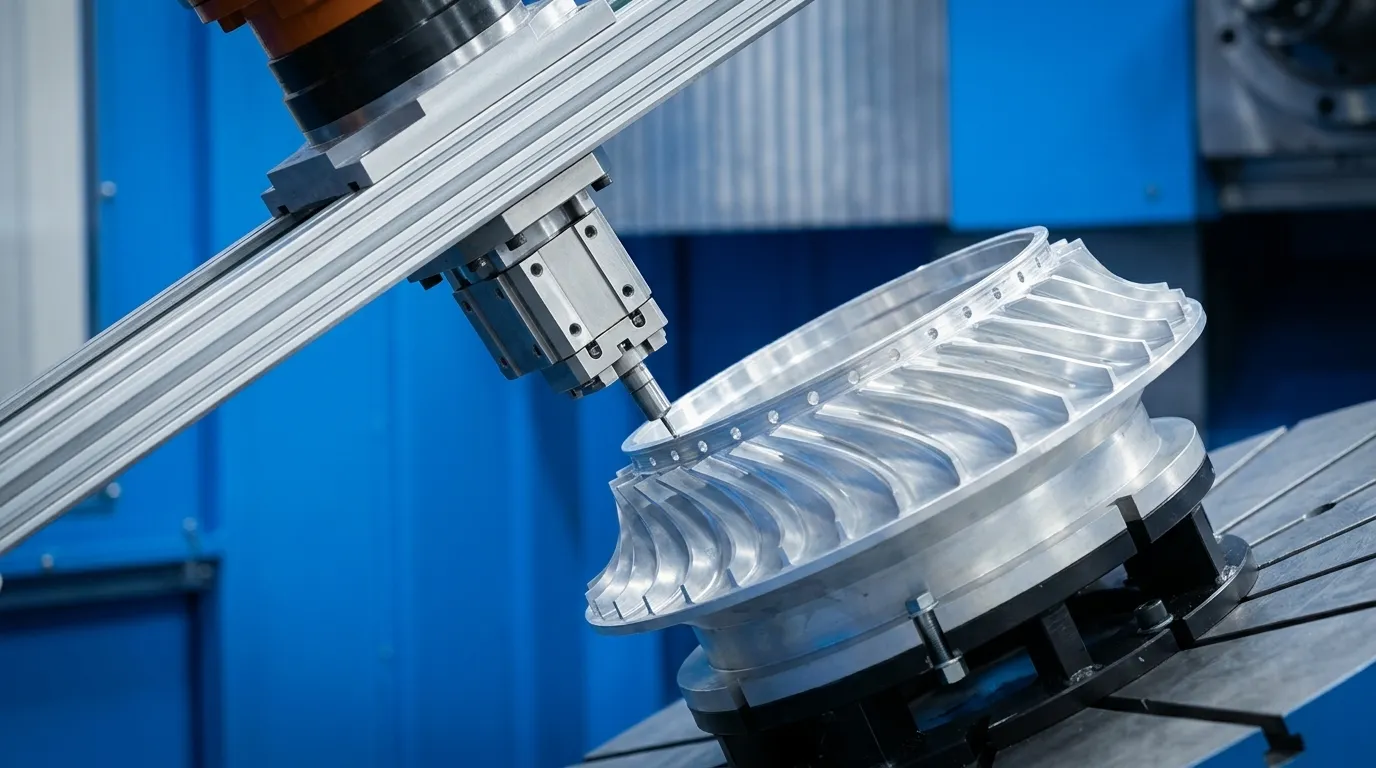
Most buyers without machining experience cannot reliably tell whether a part requires 5-axis machining. A 5-axis machine lets the cutting tool reach the part from five directions in a single setup, which supports complex geometry without repeatedly unclamping and re-fixturing the part. Some parts that can run on a 5-axis machine can also be produced on a 3-axis or 4-axis machine, but the cycle time is longer and the cost often rises.
The practical answer is to send the drawing. Redstone Manufacturing will review the part and explain whether there is a cost saving in producing it as a 5-axis part. Nobody should hesitate to submit a drawing for review.
Have Redstone review your part for 5-axis options.
FAQ
How Long Does It Take To Get A CNC Machining Quote From Mexico?
Quote turnaround depends on part complexity and how complete the RFQ is. A simple part with a STEP file, material grade, and quantity can be quoted in 1 to 2 business days. Complex parts with tight tolerances, multiple setups, or special finishing can take 3 to 5 business days. Incomplete RFQs take longer because the estimator has to ask clarifying questions before pricing can begin. Sending a complete package, including 3D model, 2D drawing, material grade, quantity, surface finish, and inspection requirements, is the most reliable way to get a fast and accurate quote.
What Files Do I Need To Send?
Send a 3D computer-aided design (CAD) model in STEP or IGES format, a 2D drawing with geometric dimensioning and tolerancing (GD&T) and critical tolerances, material grade and condition, quantity and annual volume, surface finish requirements, inspection requirements, and shipping destination. Under standard manufacturing contract law, and unless Model-Based Definition standards such as ASME Y14.41 are specified, the 2D engineering drawing takes legal precedence over the 3D CAD model. Physical samples or 3D scans can substitute where no digital file exists. If you do not have drawings, Redstone Manufacturing can reverse engineer from a physical sample or scan and produce a complete documentation package.
Do Mexico CNC Machining Quotes Include Tariffs And Shipping?
Mexican CNC machining suppliers such as EMEC in Monterrey offer EXW among their shipping Incoterms, making ex-works a common quoting basis for Mexico machining quotes. Under that Incoterm, the buyer owns freight, customs brokerage, HTS classification, and duty after the part leaves the building. A quote can look cheaper than a US quote and end up more expensive once those costs are added. The importer of record, the party legally responsible for classifying the goods and paying duties, is typically the buyer under an ex-works quote. As covered earlier, Redstone Manufacturing quotes a single landed unit price on modified DDP terms, acts as importer of record, and folds tariffs and duties into the unit price at rates in effect as of the quote date. Freight is quoted separately, prepaid and add.
Does USMCA Make Mexico Quotes Duty-Free?
USMCA duty treatment depends on North American content thresholds, not on where final assembly happens. A part machined in Mexico from Chinese or other non-North American material does not automatically qualify for preferential treatment just because it was finished in Mexico. The rules of origin in USMCA Annex 4-B typically require a tariff classification change and, where specified, a regional value content threshold. For steel and aluminum specifically, duty follows where the metal was produced, not where the part was made. A part machined in Mexico from non-North American steel can still carry Section 232 steel duties at import. The origin analysis requires knowing the bill of materials, the origin of each input, and the applicable product-specific rule for the part’s HTS classification.
How Do I Compare A Mexico Quote To My Current US Price?
A US quote includes an American point of contact, US contractual accountability, recourse if a part is wrong, quality management, and someone who owns the customs and tariff work. A Mexico quote from a direct shop transfers supplier selection, quality management, DFM, inspection, freight, customs, HTS classification, and tariff exposure to the buyer. When you compare, focus on total landed cost instead of unit price. Add freight, duties, customs brokerage, the buyer’s own time managing the program, and the cost of a bad batch with no recourse to the Mexico unit price before comparing it to a US quote.
What Is The Minimum Order?
Redstone Manufacturing works with manufacturers that have the equipment and capabilities to handle orders of various sizes.
What Payment Terms Should I Expect?
Nothing is owed until samples are approved and in-spec production parts ship. Terms are Net 30 or Net 60 from ship date. Compared with an overseas factory demanding payment in advance, this structure removes the prepayment risk that is one of the most common failure modes in direct overseas sourcing.
Request your CNC machining quote from Redstone.