




Drawing / DFM Quote / RFQ Tooling / Die Casting / Pour CNC Machining Finishing Inspection / Caliper NDT / X-ray Shipping Customs / Import Lead Time One U.S. Contact Quality Assured ISO 9001 Certified Certificate of Conformance Audit Ready Hardness / NDT Quality Cost / Landed Fit U.S. Managed Die Casting Sand Casting CNC Machining Sheet Metal Metal Injection Molding Investment Casting Automotive Medical Defense Heavy Machinery Industrial Equipment Oil & Gas Construction Agriculture Energy Aerospace Alloy / Metal

Sheet Metal Fabrication Services

Steel and aluminum sheet metal fabrication from ISO 9001 certified facilities, covering cutting, bending, welding, and finishing.

Trusted by Programs across Tier 1 suppliers, Fortune 500 OEMs & hardware startups
  • Honda
  • Libman
  • Mahindra
  • Meyer
  • MIT
  • Amazon
  • Bloom Energy
  • Circor
  • Halliburton
  • Honda
Sheet Metal Fabrication capabilities

Technical Capabilities

Review core sheet metal fabrication capabilities, materials, tolerances, inspection methods, and production requirements before requesting a quote.

Production envelope · Verified
Laser, brake, robotic 01
Cut, form, weld
Steel, aluminum, brass, copper + more 02
7 materials
Powder, anodize, plate + more 03
9 finishes
Materials
Aluminum, stainless steel, carbon steel, cold rolled steel, pre-plated steel, brass, and copper alloys
Process
Fiber laser cutting (2D and 3D), plasma cutting for thick sections, CNC turret punching, and stamping
Request a Quote

See Our Process Or same-day technical feasibility review

Sheet Metal Fabrication Routes

01 / 10
  1. Laser Cutting LC-01
    Route 01

    Laser Cutting

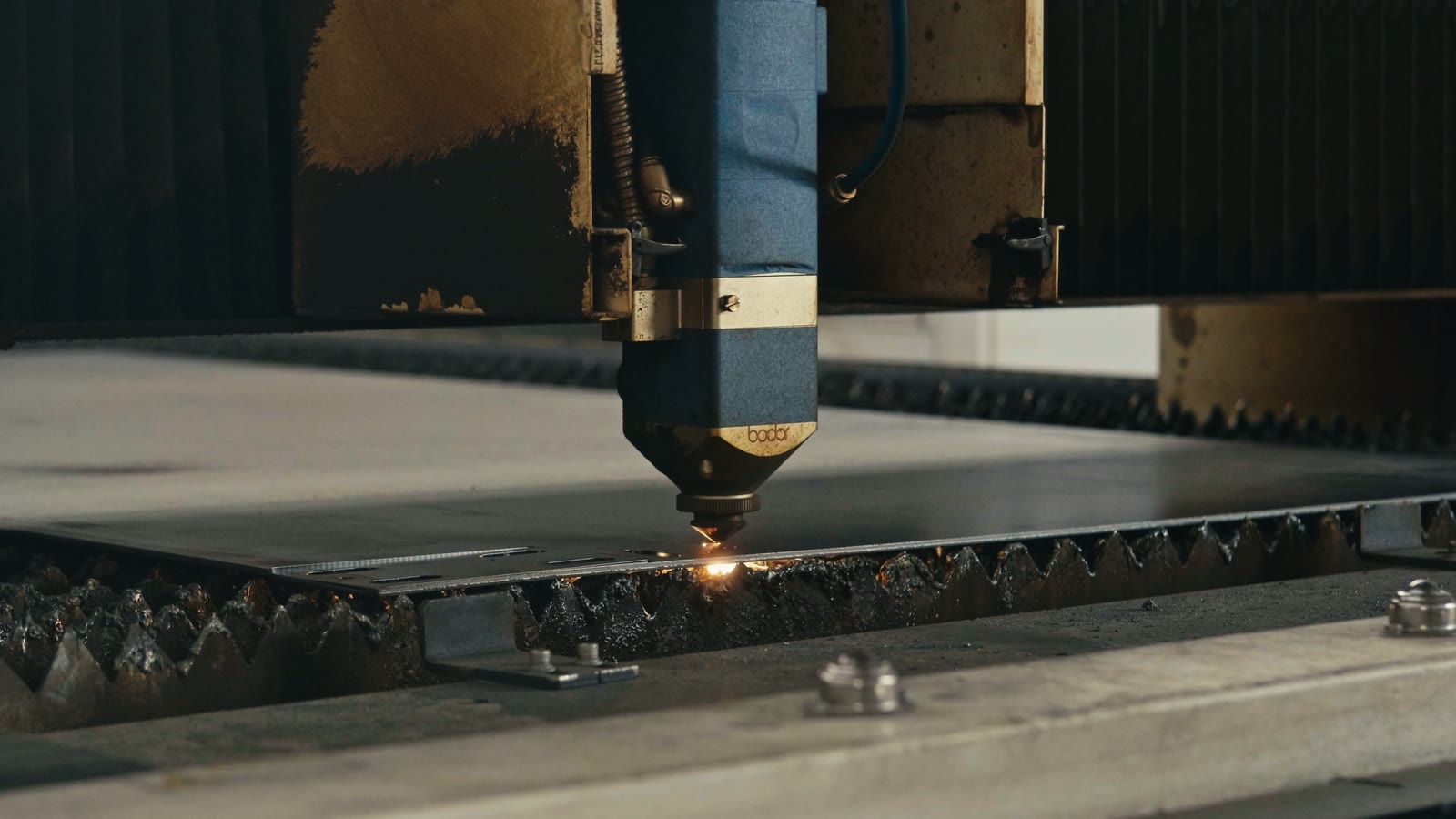
    Fiber laser cutting for tight tolerances and clean edges on flat stock.

    View capability
  2. Metal Stamping MS-02
    Route 02

    Metal Stamping

    High-volume stamped and formed parts pressed from strip stock.

    View capability
  3. Progressive Die Stamping PDS-03
    Route 03

    Progressive Die Stamping

    Multi-station dies that cut and form a part across one continuous press run.

    View capability
  4. Tube Bending TB-04
    Route 04

    Tube Bending

    Mandrel and rotary draw bending of tube and pipe to consistent radii.

    View capability
  5. Press Brake Forming PBF-05
    Route 05

    Press Brake Forming

    Bending flat sheet into U, V, L, and channel profiles on the press brake.

    View capability
  6. Water Jet Cutting WJC-06
    Route 06

    Water Jet Cutting

    Cold cutting for thick sections and heat-sensitive materials, no heat-affected zone.

    View capability
  7. Welding W-07
    Route 07

    Welding

    Welded assemblies joined and inspected with weld testing on every program.

    View capability
  8. MIG Welding MW-08
    Route 08

    MIG Welding

    Fast, strong welds for thicker steel and aluminum on production assemblies.

    View capability
  9. TIG Welding TW-09
    Route 09

    TIG Welding

    Precise, clean welds on thin material and stainless where appearance matters.

    View capability
  10. Product Assembly PA-10
    Route 10

    Product Assembly

    Sub-assembly, BOM assembly, enclosures, and chassis builds through full machine assembly under documented control.

    View capability

Production Process

01 DFM Review
02 Tooling
03 First Articles
04 Production
Next step

Ready for technical review?

Share your part details, drawings, or CAD files. Redstone will review the requirements and confirm feasibility, tolerances, materials, lead time, and next steps.

  • Feasibility review based on your drawing or CAD file
  • Material, tolerance, and production requirements confirmed
  • Quote reviewed within 24 hours
Get started Request a Quote or Talk to an Engineer

Final specifications are confirmed during the technical feasibility review.

Why Redstone

Quality, cost, and a clear fit

Redstone helps hardware teams move from released drawings to repeat production with documented quality, competitive unit costs, and engineering support from the U.S.

  • ISO 9001 certified facilities
  • U.S.-based engineering support
  • Direct manufacturing partner
Quality

Inspected to your drawing

Every program runs to ISO 9001 with dimensional inspection, weld testing, material traceability, and surface quality evaluation. Each shipment carries the documentation a customer quality audit expects.

  • ISO 9001 certified facilities
  • Dimensional inspection on every program
  • Weld testing and material traceability
  • Certificate of Conformance with every shipment
Cost

Low tooling cost, volume-driven unit pricing

Sheet metal cutting and bending carry low tooling cost compared with casting or forging, making sheet metal fabrication accessible for short and medium runs. Unit cost falls as volume grows, and complexity in welded assemblies or multi-step forming will affect pricing. We quote on landed cost with freight and duties in the number before you see it.

  • Low tooling cost for cut and bend programs
  • Unit pricing by volume tier
  • Freight and duties quoted up front, not after
  • No offshore quote desk between you and the production line
Fit

Is this a fit?

Redstone is built for hardware OEMs and industrial suppliers moving fabricated sheet metal parts into recurring production. If you are sourcing cut, formed, or welded components from released drawings, this is the lane.

  • Hardware OEMs and industrial suppliers
  • Steel, aluminum, stainless, brass, and copper sheet
  • Low to high recurring production volumes
  • Parts produced from released drawings and 3D models
Parts built for production

What we produce

Redstone supports production metal parts across automotive, electronics, industrial equipment, and consumer hardware programs.

Automotive fabricated components

Automotive fabricated components

Brackets, housings, panels, and exhaust components fabricated in steel and aluminum and inspected to ISO 9001 for sustained automotive production.

Electronics enclosures and chassis

Electronics enclosures and chassis

Sheet metal cabinets, chassis, and heat sinks held to close dimensional tolerances for electronic devices and control systems, scaling from prototype builds into volume production.

Industrial equipment and machine guards

Industrial equipment and machine guards

Conveyor components, machine guards, and control boxes fabricated in steel for durable, load-bearing industrial use.

Construction and structural metalwork

Construction and structural metalwork

Frames, supports, and architectural metal fittings cut and formed for strength and long service life in demanding environments.

From quote to production

A five-step process, documented at every handoff

From initial drawings to final delivery, Redstone keeps each stage clear, documented, and aligned with production requirements.

Each handoff is documented. No stage moves forward until drawings, materials, and production requirements are confirmed with the customer.

  1. 01

    Submit Your Drawings

    Upload your CAD model, technical drawing, or sketch in STEP, IGES, DXF, or DWG. Our engineering team reviews every submission for manufacturability, recommends the right fabrication method, and flags DFM issues before quoting.

  2. 02

    Receive a Quotation

    A detailed quote covering material options, fabrication processes, finishing, assembly, lead time, freight, and duties. One U.S. point of contact, start to finish.

  3. 03

    Process Planning and Tooling Setup

    We define cutting paths, bending programs, welding sequences, and any required tooling, then prove the setup before any production release.

  4. 04

    Fabrication and Production

    Metal sheets are cut, formed, welded, and assembled using CNC-controlled equipment, with in-process checks to hold consistent quality across the run.

  5. 05

    Finishing, Inspection, and Delivery

    Components receive the specified cosmetic and protective finish, then undergo dimensional, weld, and surface inspection. We are the importer of record and coordinate freight to your dock with a Certificate of Conformance.

Industries

Industries we fabricate for

Redstone supports production sheet metal fabrication programs for OEMs and engineering-led teams that require repeatable quality, controlled costs, and reliable part production.

  • Automotive

    Automotive

    Production components for automotive Tier 1 and Tier 2 suppliers and specialty OEM programs, run to IATF 16949 in certified facilities with U.S. engineering oversight from quote through delivery.

    • You run automotive components at production volume, not one-off prototypes.
    • Your program needs IATF 16949 quality and audit-ready documentation.
    • You are a Tier 1 or Tier 2 supplier, or a smaller OEM program that wants production-grade quality without a large-OEM minimum-order gate.
  • Electronics

    Electronics

    Production sheet metal fabrication components for electronics programs, run to documented quality with U.S. engineering oversight.

    • Recurring production volume
    • Documented dimensional inspection
    • One U.S. point of contact
  • Industrial Equipment

    Industrial Equipment

    Cast, machined, and fabricated components for industrial equipment programs, run to ISO 9001 with U.S. engineering oversight from quote through delivery.

    • You run cast, machined, or fabricated components at production volume, not one-off prototypes.
    • Your equipment operates in demanding service environments.
    • You want to consolidate multiple processes with one supplier and one U.S. point of contact.
  • Construction

    Construction

    Production sheet metal fabrication components for construction programs, run to documented quality with U.S. engineering oversight.

    • Recurring production volume
    • Documented dimensional inspection
    • One U.S. point of contact
  • Renewable Energy

    Renewable Energy

    Production sheet metal fabrication components for renewable energy programs, run to documented quality with U.S. engineering oversight.

    • Recurring production volume
    • Documented dimensional inspection
    • One U.S. point of contact
  • Consumer Products

    Consumer Products

    Production sheet metal fabrication components for consumer products programs, run to documented quality with U.S. engineering oversight.

    • Recurring production volume
    • Documented dimensional inspection
    • One U.S. point of contact

Not sure if sheet metal fabrication fits your part?

Final step

Ready to review your part?

Share your drawings, CAD files, or production requirements. Redstone will review feasibility, materials, tolerances, lead time, and the best manufacturing path for your program.

  • ISO 9001 and IATF 16949 certified facilities
  • U.S.-based engineering support
  • Quote reviewed within 24 hours
  • Production support across Redstone’s facilities in the U.S., Mexico, and China
Resources

From the engineering desk

Visit the Resource Hub

Frequently asked questions

Don’t see your question? Request a quote and our engineering team will answer it.

What is sheet metal fabrication?

Sheet metal fabrication takes flat metal sheets and forms them into finished parts through cutting, bending, welding, and finishing. The right combination of processes depends on the part geometry, material, and production volume.

What materials can you fabricate?

We work with aluminum, stainless steel, carbon steel, cold rolled steel, pre-plated steel, brass, and copper alloys. Our engineering team confirms the best material for your application at the feasibility review.

What cutting methods do you use?

We use fiber laser cutting for high-precision profiles and clean edges, plasma cutting for thick sections where laser is less efficient, CNC turret punching for repetitive hole patterns, and stamping for high-volume identical parts.

What is the difference between laser cutting and plasma cutting?

Laser cutting delivers tight tolerances and clean edges on thinner materials and complex profiles. Plasma cutting is faster and more cost effective on thicker sections where laser throughput drops. Our engineering team recommends the right method at quoting.

What finishes are available?

Standard options include powder coating, painting, anodizing for aluminum, galvanizing, electroplating, passivation for stainless steel, polishing, bead blasting, and mill finish. The right finish depends on your environmental and appearance requirements.

What are your standard lead times?

Standard production lead time is 4 to 8 weeks, with tooling and first-article timing confirmed at the quote stage. Rush programs can be reviewed case by case.

How much does sheet metal fabrication cost?

Price depends on material, part geometry, the number of cutting and forming operations, finishing, and production volume. Sheet metal carries low tooling cost compared with casting or forging, so the per-part price is driven mainly by run time and complexity, and it falls as volume grows. We quote on landed cost with freight and duties in the number, and our engineering team flags design changes during the DFM review that can reduce cost.

What are the advantages of sheet metal fabrication?

Sheet metal fabrication delivers strong, lightweight metal parts and assemblies with low tooling cost, fast turnaround, and the flexibility to scale from prototype runs to high-volume production. It supports a wide variety of materials and finishes, and design changes are inexpensive because the process relies on programmable cutting and forming rather than dedicated dies.

What file formats do you accept and what if I do not have CAD?

We accept STEP, IGES, DXF, and DWG files along with 2D drawings and flat patterns. If you do not have a finished CAD file, send a sketch or sample part and our engineering team can help develop the geometry and confirm manufacturability before quoting.

Are there design rules for sheet metal parts?

Good sheet metal design keeps bend radii consistent, holds minimum flange lengths and hole-to-edge distances, and avoids features that fight the grain direction of the material. Our engineering team reviews every drawing for these manufacturability factors and recommends adjustments that improve quality and reduce cost.

What are the most common sheet metal design mistakes?

Holes or features placed too close to edges, small hole diameters that do not account for sheet thickness, short tabs, and tight bend radii are the most frequent problems Redstone sees during DFM review. These features look simple in a 3D model but require secondary operations or manual correction in production, each adding cost that a design revision could prevent.

How does Redstone inspect sheet metal parts before shipping?

Redstone balloons every callout from the drawing into an inspection template, covering all dimensions, notes, material, and the title block. A second review pass adds lessons from past quality issues and from understanding how the parts assemble with mating components. Critical dimensions get extra rigor and are reviewed with the manufacturer before production. Pre-ship reports include CMM data, material certificates, and functional checks where assemblies are involved.

When should I choose stamping over laser cutting?

The decision comes down to quantity and design stability. Stamping dies require investment but deliver a much lower per-part cost, with progressive-die options for high-volume runs. Laser cutting has no die cost and handles design changes easily, making it the right fit for smaller runs or parts still in development. Redstone helps you evaluate the crossover point during the quote process.